Polystone vs. PU Resin: Which Material is Best for Your Premium Statue?
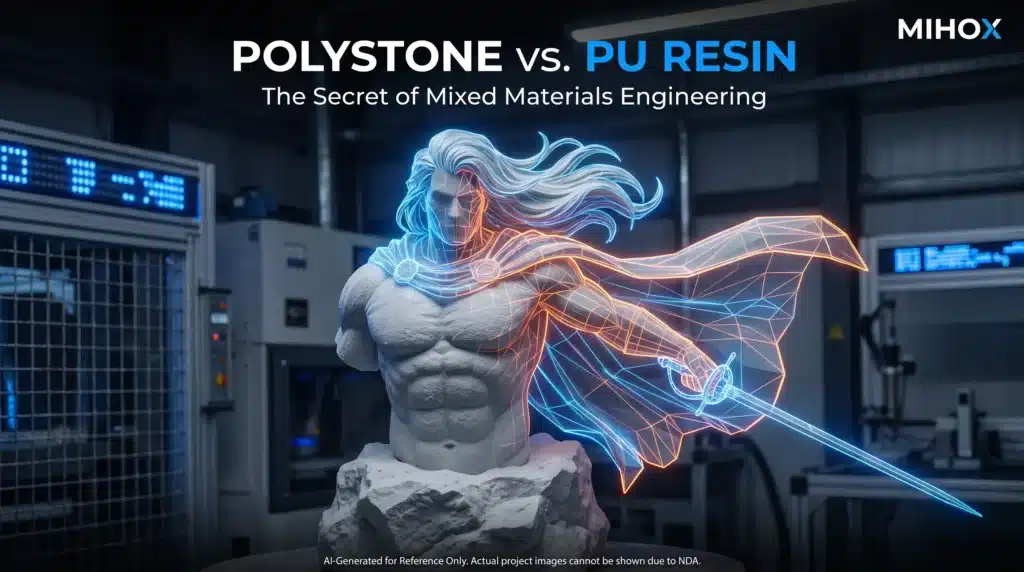
Polystone or PU Resin? Discover why relying on one material is a risk, and how MIHOX’s mixed materials strategy crafts the ultimate shatterproof statue.
Table of Contents
Let’s talk about a soul-searching question almost every creator faces when stepping into the premium statue circle.
When you’ve finally been around the block in this industry long enough to move beyond tiny blind boxes, and you decide to launch a limited-edition, large-scale statue priced over $300 or even $1,000, your OEM factory boss will casually ask you over the phone: “For this mass production run, do you want to go with Polystone or PU?”
At that moment, the air usually goes dead silent for a few seconds.
You know, these two words are absolutely legendary in toy manufacturing. But if you aren’t an engineer who spends years in a workshop smelling chemical solvents, you might genuinely be completely clueless. Which one should you choose? Does a heavier material automatically mean it’s more premium? What if you choose incorrectly, and the whole batch shatters into expensive dust during transit?
Honestly, there is no need to panic. Today, let’s toss aside those confusing chemical formulas. Like two old friends chatting over coffee, we are going to lay all the cards on the table regarding premium statue materials. I will tell you the unique temperaments of these two materials, and how we tame them on the assembly lines here at MIHOX.
Polystone: The “Heavyweight” Superstar You Love to Hate
Let’s start with Polystone. If you have ever picked up a statue at a comic convention and couldn’t help but gasp, “Wow, this has some serious weight to it,” chances are, it is made of Polystone.
What exactly is Polystone? Well, it is not some magical stone mined from nature. It is essentially a composite material made by mixing liquid resin with extremely fine stone powder (usually calcium carbonate).
Adding stone powder gives it a few incredibly charming characteristics. First, its sense of weight is unmatched. In the subconscious minds of many veteran collectors, “heavy” equals “expensive” and “solid material.” When you place a pure Polystone base in a glass display cabinet, that heavy, hand-pressing weight and slightly cool touch instantly max out the product’s premium vibe.
Second, Polystone becomes incredibly hard after curing, and its surface boasts excellent adhesion. This means whether you want to paint the cold, sharp texture of metal or the rough, battle-damaged details of armor, the paint bites onto it tenaciously.
But—yes, there is always a “but.” Polystone’s temper is also notoriously bad.
It is simply too hard, hard to the point of having almost zero flexibility. Think of it like a beautiful piece of glass. It looks stunning sitting there, but the moment it suffers an impact—even just dropping from a one-meter-high desk—it won’t bounce like soft vinyl. Instead, it will just snap and shatter into tragic, massive chunks.
Does spending top dollar only buy you a pile of fragile rocks?
This brings us to a reality that gives countless brand owners headaches: if you use pure Polystone to craft a character’s ultra-fine hair, the fluttering edges of a cape, or an extremely sharp sword blade, shipping those items is basically gambling. If the courier is even slightly rough, your players will open the box to a tragedy. This forces us to find another, more flexible alternative.
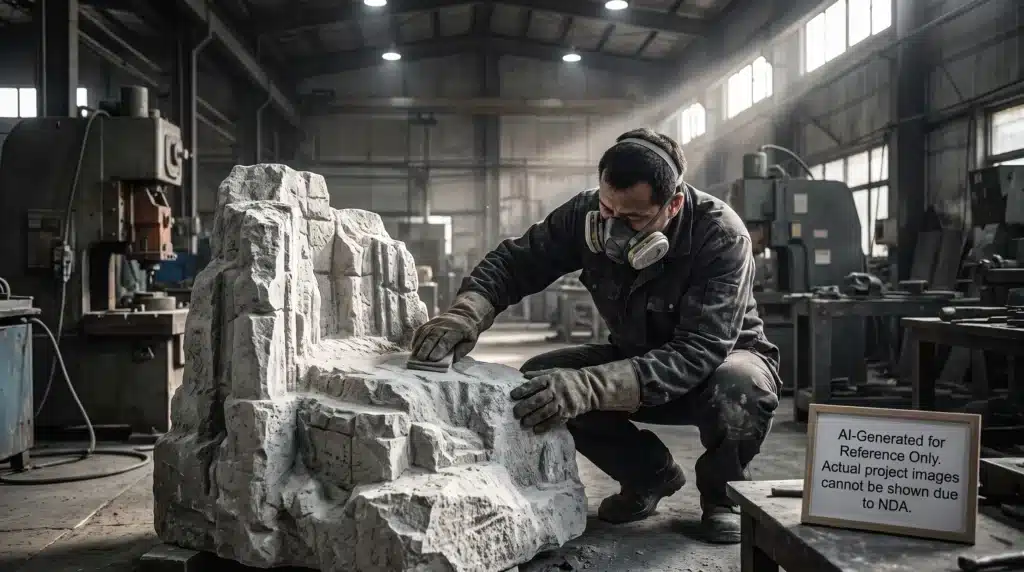
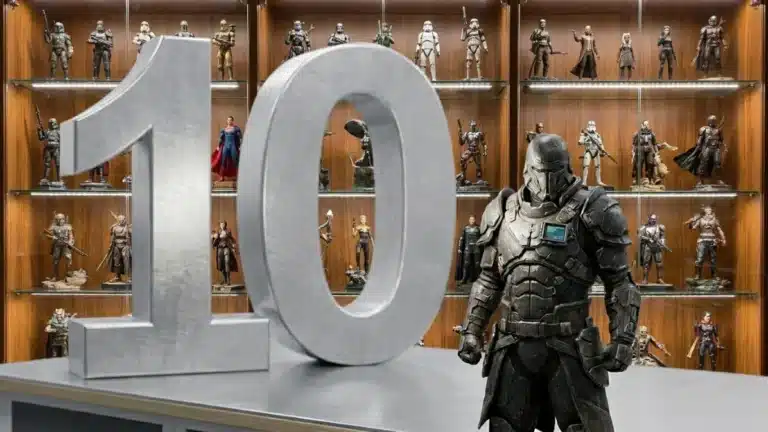
Polystone provides the unmatched weight and “cool stone touch” that collectors associate with high-value premium statues. [AI-Generated for Reference Only. Actual project images cannot be shown due to NDA.]
PU Resin: The Detail Maniac That Captures the Soul
Since Polystone cannot handle those fragile, extreme details, who will save those stunning designs? Welcome to the home turf of PU Resin (Polyurethane Resin).
If Polystone is the solid, grounded earth, then PU Resin is the agile, flowing water. It is a pure chemical polymer, completely free from any heavy stone powder.
Do you know what makes prototype sculptors and 3D modelers go crazy for PU? It lies in its absolutely insane ability to reproduce details. When liquid PU is injected into a silicone mold, it has superb fluidity, capable of seeping into crevices thinner than a fingerprint. Whether it’s the incredibly dense fabric texture on a character’s clothing or hair blowing in the wind, PU can replicate it 100% perfectly.
More importantly, PU retains excellent flexibility after curing.
If you pinch a sword blade made of high-quality PU and gently bend it, you will notice it flexes slightly and then quickly snaps back to its original shape, instead of just breaking. This microscopic elasticity is essentially a “get out of jail free card” during long-distance logistics. Using it to craft a character’s antennas, weapons, and ribbons causes defect rates and after-sales return rates to drop off a cliff.
However, PU is not flawless either.
The biggest controversy surrounds its “feel.” Because it lacks the added stone powder, PU is much lighter than Polystone at the same volume. Some players who are new to collecting statues might frown slightly when touching a 100% PU product: “Why does this feel a bit like flimsy, cheap plastic?”
Additionally, if you accidentally leave it on a windowsill under direct summer sunlight, or subject it to long-term heat, certain low-quality PU parts might slightly warp or soften. This requires factories to implement extremely strict controls over their material formulas.
Shattering the Stereotype: “Heavier is Always Better” is a Complete Lie
Speaking of this, we need to slightly detour and talk about a widely circulated myth in the collecting circle.
Many indie creators making a statue for the first time will stubbornly demand from their OEM factory: “I want to use Polystone for everything! I want my players to feel like their $500 was well spent!”
Honestly, this mindset is extremely dangerous.
First, making a massive 1/4 scale statue entirely out of Polystone results in a truly terrifying weight. Do you think players will thank you for giving them a 20-kilogram block of iron?
When you calculate the cross-border shipping fees, you will wake up instantly. Those exorbitant overweight surcharges will suck your profit margins dry like a vampire. Not to mention, to protect this incredibly fragile behemoth, you have to custom-make absurdly thick and heavy EPE or EPS foam packaging. Ultimately, you are paying top dollar to ship air and foam.
Weight does bring a certain premium feel, but if you blindly chase weight at the expense of detail expression, and even dramatically increase the risk of shipping damage, it is absolutely a terrible deal.
The Ultimate Answer: Top-Tier Factories Take It All
So, as a brand owner with extremely high quality standards, what should you choose?
The answer is actually quite simple, and it is the unspoken industry secret currently used by all top-tier international studios: Mixed Materials Engineering.
Why hang yourself on one tree? In the advanced assembly workshops at MIHOX, we abandoned the single-material mindset a long time ago. A truly perfect premium statue is, in itself, an incredibly complex physical puzzle.
Here is how we do it:
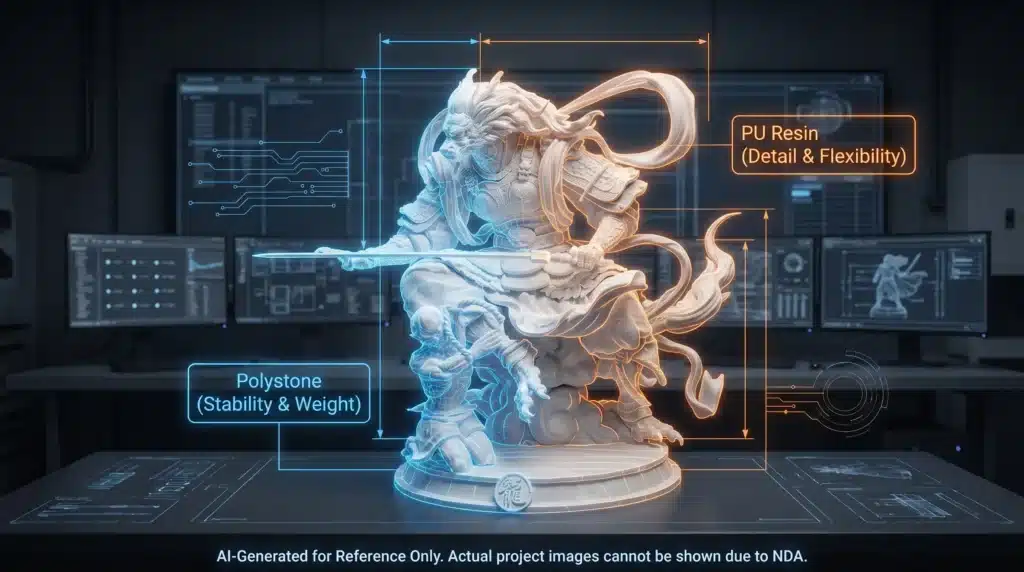
We assign the largest, core base of the statue (like mountain rocks, ruins, or an iron throne), along with the character’s thick torso and legs, entirely to Polystone. This firmly anchors the center of gravity, making it sit as steady as a mountain on a desk, while giving players that highly desired heavy, hand-pressing feel.
Then, for those easily breakable slender arms, exaggerated weapons, swirling magic effect parts, and the facial sculpts and hair that define the character’s soul, we unhesitatingly use imported, high-grade PU Resin. We leverage PU’s extreme precision to showcase mind-blowing details, and its flexibility to withstand the abuse of rough couriers.
Finally, through extremely precise snap-fit designs (like built-in strong magnets or metal steel pins), we seamlessly splice these two materials together. After painting, the naked eye of a player cannot tell where the Polystone ends and the PU begins. They will only marvel at how the product has both astonishing weight and details as delicate as a fine craft.
Now that is a truly smart approach, isn’t it?
The Best of Both Worlds: Using PU Resin for soul-defining details and Polystone for core weight and stability. [AI-Generated for Reference Only. Actual project images cannot be shown due to NDA.]
Frequently Asked Questions (FAQs)
Can I fix a broken Polystone statue myself with glue? The broken cross-section of Polystone is usually very rough. While you can try using strong AB epoxy or cyanoacrylate (super glue) to bond it, because the material lacks flexibility, the repaired seam is often glaringly obvious, and the structural strength of that area will be heavily compromised. This is exactly why premium statues must replace extremely fragile parts with PU Resin.
Will PU Resin actually suffer from heat deformation and sagging during long-term display? If a factory uses cheap, low-quality PU raw materials, or if the character’s load-bearing structure has a severe design flaw (like a massive volume supported by a single hovering foot), there is a real risk of slight bending and sagging over time in high-temperature environments. Reputable OEM factories will insert high-strength steel wires or rods inside load-bearing parts for support, completely eliminating this hidden danger from the root.
Why is an all-PU statue usually more expensive than an all-Polystone statue? Although Polystone is heavier in volume, its raw material is heavily mixed with low-cost stone powder. High-quality, industrial-grade PU Resin, however, is a pure chemical polymer, meaning its cost per gram is inherently higher. Furthermore, the scrap rate during PU casting, the wear and tear on silicone molds, and the strict requirements for equipment like vacuum degassing machines are far more demanding than for Polystone, all of which indirectly drive up manufacturing costs.
How do I communicate the need for Mixed Materials to the factory in my Tech Pack? You do not need to be a material chemistry expert. When submitting 3D files for prototyping evaluation, you simply need to clearly annotate your core demands on an exploded view drawing. For example, circle the load-bearing base and note “must ensure weight and center-of-gravity stability,” and circle long, thin weapons or ribbons and note “must prevent breakage / high flexibility.” Experienced factory engineers will automatically match the optimal distribution ratio of Polystone and PU Resin for you.
Is there a difference in how Polystone and PU Resin absorb paint? Both can display incredibly excellent painting results. Polystone’s surface has microscopic pores, giving it a very strong grip on primers, making it perfect for colors that need a heavy, rough texture (like rock or weathered metal). PU Resin, on the other hand, has a denser, smoother surface, making it ideal for spraying glossy paints that require high reflectivity and subtle gradients (like an automotive-grade finish or ultra-translucent skin tones). Excellent factories will adjust primer formulas based on the material’s traits to ensure absolutely zero color discrepancy in the final product.
Curious about how soft vinyl toys are manufactured? We take you inside our custom figure factory to show the real production process, from mold making to final assembly. Click to see the craftsmanship behind the toys.
Fill out this form and we'll respond within 24 hours
🐎
MIHOX 2026 SPRING FESTIVAL
Year of the Horse • 丙午马年
Homecoming for the Heart | Galloping Towards a Warm Reunion
Dear Friends,
As the hoofbeats of the Year of the Horse draw near, the air is filled with the spirit of vitality and the warmth of tradition. In Chinese culture, the Spring Festival is our most sacred time—a moment to “gallop home,” no matter how far, to reunite with family for the New Year’s Eve feast and share the joy of togetherness.
Holiday Begins
February 7th, 2026
Back in Action
March 2nd, 2026
🤖The Humans are Resting, but the MIHOX AI Stays Online.While we are celebrating the holiday with our families, we don’t want to keep you waiting. Our AI Intelligent Assistant will be available 24/7 to support you. It can handle about 60% of common questions and provide quick answers to your inquiries — feel free to give it a try.
For any personalized requests, please leave a message. We promise to return with the vigor and speed of a galloping horse on March 2nd to handle all your needs.
Thank you for your incredible support throughout the year. May your Year of the Horse be filled with strength, success, and endless joy!
Stella Yan, the founder of Newmiho Cultural & Creative Co., Ltd., has 15 years of experience in the custom figurine and toy manufacturing industry. He/She specializes in providing one-stop solutions for global brands, designers, and IP owners.
He/She founded the company to solve common industry challenges—communication gaps, inconsistent prototypes, and the difficulty of producing small batches. His/Her goal is to build a fully transparent and controllable workflow covering design, prototyping, mold development, and mass production.
Under his/her leadership, the company has delivered 20000+ resin, vinyl, and plastic figure projects for clients across Europe and the United States, supported by a mature quality management system that ensures stable and reliable results.
His/Her vision is simple: to bring great characters and ideas to life through high-quality products recognized worldwide.
Production Timeline Back-Caster
404
We are very sorry that this page is under maintenance. Please browse other pages.