True art toy collectors share a hard-to-break muscle memory.
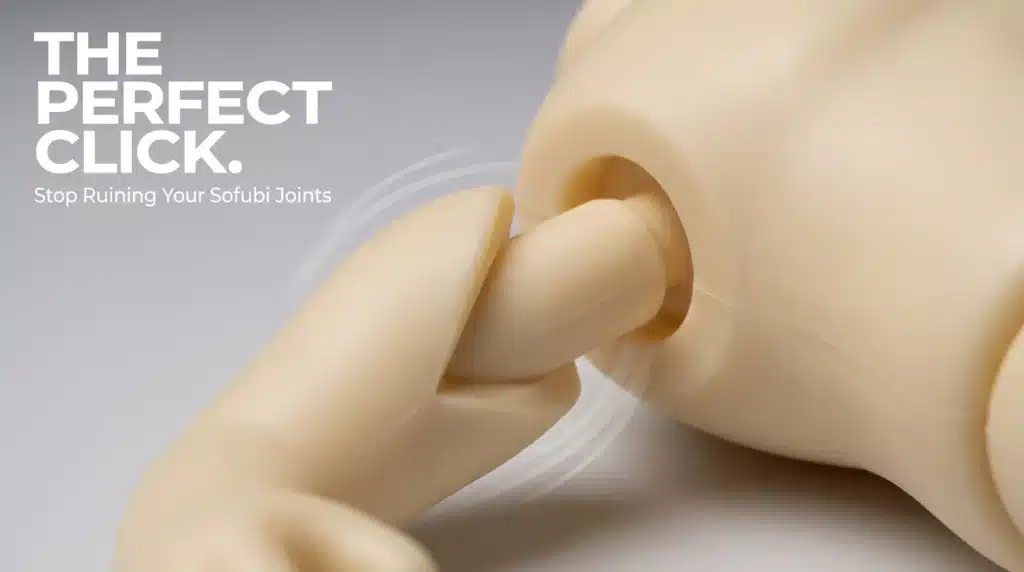
When they pick up a newly released soft vinyl (Sofubi) monster, their first move is rarely to lean in and admire the glossy paint. Instead, they naturally grab the monster’s arm and give it a gentle twist. If their fingers feel a buttery-smooth, premium resistance accompanied by a faint, satisfying “click,” they secretly nod in approval: “These guys know their stuff.”
Conversely, if the arm feels sloppy, like it might drop to the floor at any second, or if twisting it lets out a screeching plastic friction sound—no matter how stunning the paint job is, the toy’s perceived value drops instantly in the player’s mind.
Honestly, turning a 3D model that spins perfectly on a computer screen into a physical toy that twists smoothly in the real world is way more complicated than it looks. It is absolutely not about randomly digging a hole and shoving a cylindrical peg into it. Today, we are skipping the superficial design trends. Let me explain the engineering core that dictates the life or death of your handling feel: the V-Cut Joint.
The “Physical Curse” of Soft Vinyl: Why Is Smooth Rotation So Hard?
To understand why the V-Cut is so brilliant, we first need to face a slightly harsh manufacturing reality: the physical limitations of soft vinyl.
If you are making hard action figures like Gundams, things are pretty straightforward. Those toys usually rely on ultra-rigid engineering plastics like ABS or POM. You can easily stuff precise ball joints or gear hinges inside them. The mechanical structure is right there; it moves exactly how you want it to.
But the PVC slush casting process is a completely different beast.
Soft vinyl toys are entirely hollow. They have no internal skeleton, nor do they have separate mechanical joint parts. What we call a “joint” is purely two pieces of somewhat flexible plastic squeezing, rubbing, and biting into each other. This creates an incredibly contradictory mechanical puzzle.
If you use the most basic flat cut—just a straight cylindrical peg and a round hole—you will quickly realize that tolerances are impossible to control. Make the peg a tiny bit too small, and the arm acts dislocated, falling to the ground if you just look at it wrong. Make it a bit too large, and it gets dead-stuck inside the torso. When you try to force it, the massive friction resistance not only tires your hands but also brutally scrapes the paint off the edges.
We need a much smarter geometric design to break this deadlock. This is exactly where the V-Cut steps into the spotlight.
Dissecting the V-Cut: It Is Not a Simple Chamfer
Sound like some obscure industrial jargon? The truth is, you have already experienced its operating principle countless times in your daily life.
Stop thinking about electrical plugs and sockets. Think about the metal snap button on your heavy winter jacket. At first, you need a little clever force to push it down. But once that microscopic groove catches, it locks perfectly with a crisp “click.” Not only does it stay put, but you can also spin it freely in place.
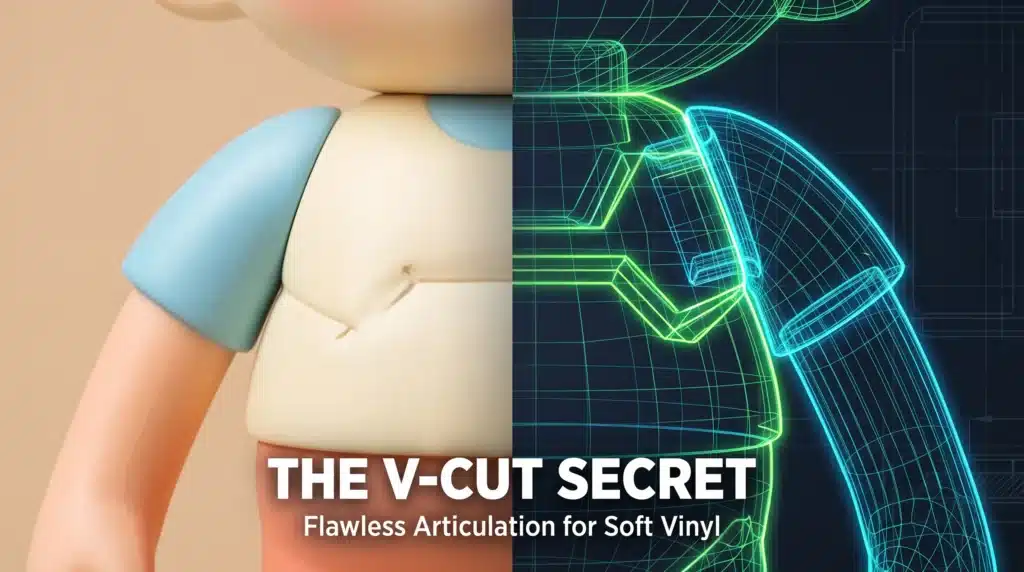
In 3D modeling software, the cross-section of a V-Cut looks somewhat like an upside-down mushroom head.
Its top features an angled V-chamfer, usually sitting between 45 and 60 degrees. This angled plane is absolutely crucial. It is essentially a physical slide. When factory workers assemble the toy, this slope guides the arm peg incredibly smoothly into the torso hole.
Right next to the slope is an inward-shrinking neck groove. After the peg fully enters the hole, the flexible plastic edge of the torso hole instantly snaps back, locking precisely into this groove.
Once the bite is successful, the V-Cut provides continuous and even radial tension. It locks the piece down tight to prevent dropping, yet leaves a microscopic gap. This gives you that satisfying, heavily damped feeling when twisting the toy, almost as if it were greased. This is pure magic created entirely by geometry.
[AI-generated for reference only. Actual product cannot be disclosed due to NDA.]
The Ghost in the Factory: The Ignored Shrinkage Rate
You might be thinking, “Since the logic is so clear, I will just build a perfect V-Cut model in ZBrush tonight!”
Seriously, hold your horses. The biggest roadblock has not even shown up yet. Many new designers are so used to “what you see is what you get” with 3D printing. They assume a digital model accurate to 0.01 millimeters will fit together flawlessly in mass production.
In a real manufacturing workshop, that zero-tolerance 3D file is a ticking time bomb. Who is the culprit? Heat, and the resulting “shrinkage rate.”
In slush casting, we bake liquid PVC inside scalding hot copper molds. As the soft vinyl gets pulled out and slowly cools to room temperature, the entire toy’s volume irreversibly shrinks by about 3% to 5%.
Here is a highly counterintuitive physical trap: the toy does not shrink evenly.
Because the torso is bulky and holds more trapped air, it cools and shrinks at a completely different speed compared to a smaller, complex arm. This means even if you drew the arm peg and the torso hole as perfect circles on your computer, that hole might unpredictably warp into a slight oval after enduring the furnace.
This asymmetrical deformation instantly shatters the fragile mechanical balance of the V-Cut. This is exactly why so many creators suffer mental breakdowns during mass production inspections. You must rely on rich engineering experience during the 3D modeling phase to artificially enlarge the peg’s diameter by 0.5 to 1 millimeter, leaving enough room for later shrinkage.
The Paint Thickness Betrayal: Where You Should Never Spray
Alright, let us say you found a veteran mold engineer who perfectly calculated the shrinkage tolerance. You finally get the blank prototypes, and the V-Cut turns smooth as butter.
Time for paint! A few weeks later, the fully painted samples arrive. You happily twist the arm—”Crack.” Accompanied by a heartbreaking sound, you horrifyingly realize a huge chunk of premium paint was brutally scraped off the joint, exposing the dull grey primer underneath.
This kind of paint-chipping disaster is a major scandal that can easily destroy brand trust among collectors.
Where did things go wrong? Many creators totally forget that paint has physical thickness in the real world. Whether it is primer, base coat, or the final glossy topcoat, every single spray adds fractions of a millimeter to the peg and hole surfaces. Those layers completely choke out the originally perfect tolerance.
What is the smart, experienced move here? Clearly state in your Tech Pack specifications that factory workers are strictly forbidden from spraying any primer or topcoat on the internal friction surfaces of the V-Cut peg. Alternatively, intentionally leave “breathing room” for this paint layer during the 3D design phase. Success often hides in these easily ignored details.
Hairdryers and Boiling Water: The Violent Beauty of Traditional Craftsmanship
We nailed the design, calculated the shrinkage, and prevented the paint chipping. Now we arrive at the final boss of mass production: assembly.
If you step onto an OEM factory assembly line for the first time, you will probably be shocked by what you see. Workers are not using tiny tweezers to carefully assemble toys like watchmakers. Instead, you might see large pots of boiling water steaming away, or hear the deafening roar of industrial heat guns.
This is a traditional craft filled with violent beauty, yet incredibly smart.
Because soft vinyl is relatively hard at room temperature, brute-forcing a larger V-Cut peg into a smaller hole will easily tear the hole’s edges right open. So, what do experienced assembly masters do? They toss the toy’s torso (the part with the hole) into boiling water for a dozen seconds, or blast the hole directly with an industrial heat gun. The high heat instantly softens the PVC, opening its pores and making the hole extremely elastic.
In that split second, the master uses years of muscle memory. They grab the room-temperature, relatively hard arm peg, run it along that V-chamfer, and swiftly, accurately, and ruthlessly pop it into the torso with a loud “click.”
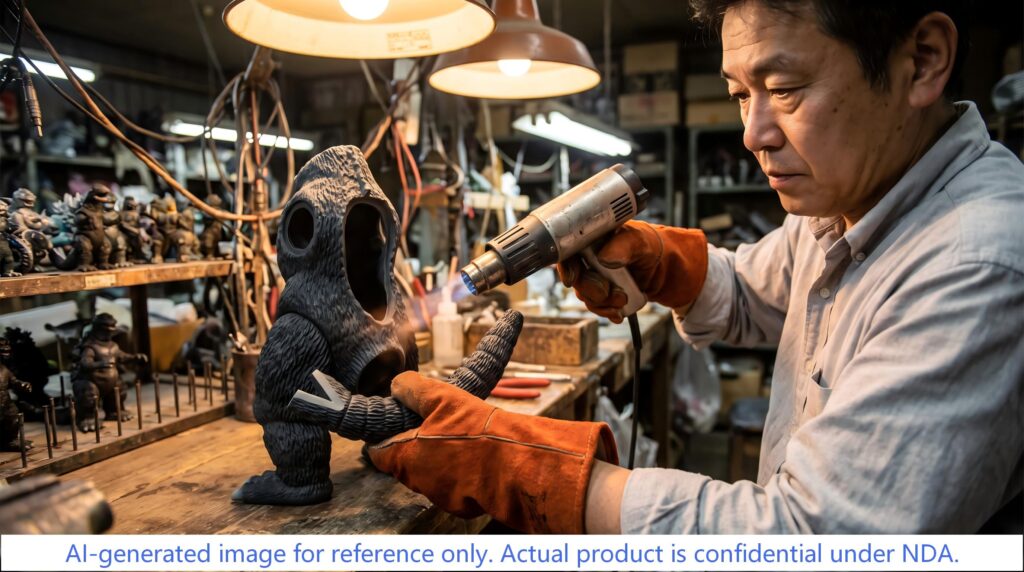
A few seconds later, the torso cools and shrinks, and the hole’s edges bite down onto the peg’s neck like a vice. A rock-solid, buttery-smooth perfect joint is born. When you pay for a premium manufacturing quote, you are not just buying plastic and paint. You are buying the tactile feel and ultra-low defect rates accumulated in these masters’ wrists over the years.
Actionable Anti-Pitfall Advice for Creators
Now that you see right through these underlying mechanics, how should you, as an IP owner or indie artist, control your product quality? I have put together a few field-tested tips you will definitely need:
The hardness of your soft vinyl dictates whether your joint lives or dies. If the material is too soft (say, below Shore 50A), the toy acts like mud; the joint lacks support, and the arm just drops by itself. If it is too hard (above Shore 80A), twisting the arm in winter feels like bending raw iron. During the prototyping phase, you must physically feel the handling feedback of different hardness levels.
Many 3D artists have a habit of sculpting characters as a single, rigid chunk. Listen to me, if you want articulation, you must personally split the arms and head in your software before sending files to the factory. Even if your dimensions are off, drawing a rough V-Cut sketch helps the factory engineers understand your design intent. This saves endless back-and-forth communication.
Your toy might ship to a scorching Miami summer, or it might end up in a freezing Moscow winter. Once you get the blank prototypes, try tossing them in the freezer overnight, then take them out to see if the joints crack when twisted. Or, leave them baking on your car dashboard in summer to see if the joints get mushy and fall out. Extreme testing helps you avoid almost all potential customer return nightmares.
Wrapping It Up
So you see, creating a soft vinyl joint with a perfect V-Cut does not rely on some elusive luck.
It is an industrial masterpiece built on precise geometric math, ruthless prediction of material shrinkage, seasoned manual assembly skills, and countless trials and errors. When you see players pick up your toy at a convention and sigh, “Wow, this rotation feel is incredible,” you will realize all those late nights arguing over tolerances on the factory floor were totally worth it.
Do not let stiff, lifeless joints hold back your stunning character designs. Once you master the secrets of the V-Cut, you can inject real soul and long-lasting playability into your art toys. That is whe
Frequently Asked Questions (FAQs)
- What exactly is the fundamental difference between a Flat Cut and a V-Cut in soft vinyl toys? A flat cut is simply a straight cylindrical peg inserted into a round hole. It relies entirely on natural surface friction to stay in place, meaning it gets loose and falls off incredibly easily after playing. A V-Cut features an angled chamfer and an inward groove. Once inserted, it forms a physical mechanical snap-fit structure. This not only strongly prevents dropping but also provides a much smoother, premium rotational damping feel.
- Why do my soft vinyl toy joints become incredibly stiff and impossible to twist in the winter? This is dictated by the physical properties of PVC material itself. Soft vinyl is extremely sensitive to temperature. In cold environments, the plastic molecules pack tighter, causing the material to harden and shrink. This causes the originally tight-fitting V-Cut joint to lock up completely. If this happens, never brute-force it. Just use a household hairdryer to evenly heat the joint for 10 to 15 seconds. Once it softens slightly, it will return to its buttery-smooth state.
- When designing 3D joint tolerances, how much larger should the peg be compared to the hole? There is no universal, one-size-fits-all formula for this, because it heavily depends on your chosen PVC Shore hardness and the wall thickness of the parts. However, a common engineering rule of thumb is that to ensure a tight V-Cut bite, the maximum outer diameter of the peg should usually be about 0.5 to 1 millimeter larger than the molded inner diameter of the hole. This microscopic interference fit is the key to creating that perfect handling feel.
- If the mass production batch comes out and the V-Cut joint is too loose, can the factory still fix it? It gets pretty tricky, but it is not entirely hopeless. If it is only slightly loose, the factory can try to slightly extend the heating time of the torso inside the mold for subsequent batches to increase the wall thickness, or they can tweak the hardness formula of the raw PVC. But if the size deviation is too massive, the only solution is to swallow the pain and modify, or even remake, the copper mold for that specific part.
- Can I just use 3D-printed resin parts to test the smoothness of my V-Cut joints? We highly advise against doing this. Photosensitive resin is a hard and brittle material. It completely lacks the resilient elasticity and deformation capabilities of PVC soft vinyl. If you print a V-Cut joint in resin, you either will not be able to push it in at all, or it will just snap in half if you force it. You should only use resin prototypes to verify shapes. To test the true handling feel of a joint, you must spend the money to get a real vinyl test shot.